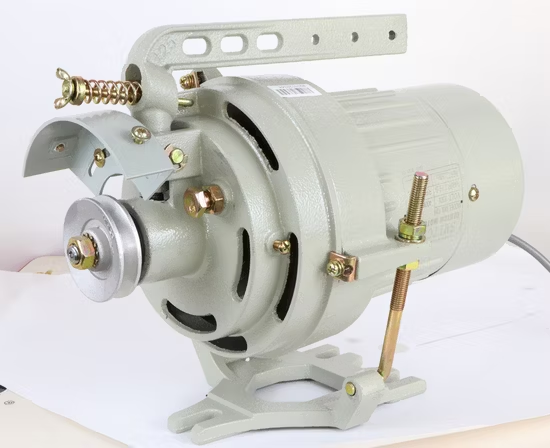
In the highly competitive landscape of the Ready-Made Garments (RMG) industry, operational efficiency and cost minimization are the cornerstones of profitability. For garment factory owners, production managers, and technicians, selecting the right machinery is a critical decision. One of the most significant technological shifts in recent years is the transition from traditional clutch motors to modern, energy-saving servo motors on industrial sewing machines. This comprehensive guide evaluates both technologies to help you make an informed upgrade decision for your production line.
Understanding the Technology: Clutch Motors vs. Servo Motors
For decades, the clutch motor has been the workhorse of the apparel manufacturing industry. Operating at a constant speed (usually 2850 to 3450 RPM), a clutch motor runs continuously from the moment the machine is switched on. When the operator presses the foot pedal, a mechanical clutch engages to transfer power to the sewing head. This design results in constant energy consumption, high noise levels, and significant heat generation, even when the operator is positioning the fabric and not actively sewing.
In contrast, an energy-saving servo motor utilizes advanced brushless DC technology and electronic speed controllers. The motor only rotates when the operator presses the foot pedal. When the pedal is released, the motor stops instantly. Furthermore, the speed can be digitally adjusted with precision, allowing for better control over different fabric types and sewing operations. This fundamental difference in operation leads to massive savings in electricity and improved operator performance.
Key Benefits & Technical Specifications
- Exceptional Energy Efficiency: Servo motors consume power only during actual sewing cycles. On average, upgrading to a servo motor reduces electricity consumption by 60% to 80% compared to traditional clutch motors. For a large-scale factory operating hundreds of machines, this translates to thousands of dollars saved monthly in utility bills.
- Precise Speed Control: While clutch motors operate at a fixed, high speed that requires manual feathering of the pedal, servo motors allow technicians to set maximum speed limits digitally. This is crucial for delicate operations, collar shaping, and training new operators.
- Reduced Noise and Heat: Clutch motors generate a continuous, loud humming noise and substantial ambient heat. Servo motors operate almost silently and run cool. This drastically improves the factory floor environment, reducing operator fatigue and lowering the air conditioning load.
- Higher Productivity with Needle Positioners: Most modern servo motors support synchronizers (needle positioners) which ensure the needle stops either consistently up or down. This eliminates the need for operators to manually turn the handwheel, speeding up cycle times by 10% to 15%.
Maintenance, Safety, and Longevity Tips
Transitioning to servo motors not only reduces energy bills but also alters your maintenance protocols. Because servo motors have fewer mechanical wear-and-tear parts (such as clutch plates and brake pads), they require significantly less routine maintenance. However, because they rely on electronic microprocessors, protecting them from environmental hazards is essential.
- Voltage Stabilization: Industrial power grids in apparel manufacturing hubs can experience voltage fluctuations. Ensure your factory uses proper voltage stabilizers to protect the sensitive electronic control boxes of your servo motors.
- Dust and Lint Prevention: Fabric dust and lint are major enemies of electronic circuits. Regularly blow out the cooling fans and control boxes of the servo motors with compressed air to prevent overheating.
- Correct Belt Tension: Ensure the drive belt is adjusted to the manufacturer’s recommended tension. Over-tightening can strain the motor bearings, while a loose belt reduces power transfer efficiency.
Conclusion: Upgrading from outdated clutch motors to energy-saving servo motors is no longer just an option; it is a necessity for factories aiming to stay competitive, reduce carbon footprints, and lower overhead costs. At RMB Trading Solution, we understand the pressure of modern garment manufacturing. As Bangladesh’s premier supplier of premium garments machinery, we offer high-efficiency, authentic energy-saving servo motors, state-of-the-art industrial sewing machines, and genuine spare parts. Contact RMB Trading Solution today to consult with our technical experts and modernize your production floor for maximum profitability.